

INVESTMENT UPDATE APRIL
|
Index |
Level 28 Feb |
Level 31 March |
Change* |
|
S&P 500 |
6879 |
6528 |
-5.1% |
|
FTSE 100 |
10910 |
10213 |
-6.4% |
|
Euro Stoxx 600 |
633 |
584 |
-7.7% |
|
Nikkei 225 |
58057 |
51063 |
-12.0% |
|
Shanghai |
4162 |
3891 |
-6.5% |
|
US 10 Yr Treasury Yield |
3.96% |
4.31% |
+0.35 |
|
UK 10 Yr Gilt Yield |
4.30% |
4.91% |
+0.61 |
|
Bund 10 Yr |
2.65% |
3.01% |
+0.36 |
*all returns in local currency terms. Past performance is not a guide to future returns.
Overview
Unsurprisingly, the Israel/US war against Iran dominated market sentiment during March. The constant flow of news about the conflict initially caused large swings in global indices, but it was the price of crude oil and related energy products that ultimately dictated the extent of that market volatility. The level of impact varied by region. Those markets which are almost wholly reliant on the Gulf for their energy needs were the ones that felt the impact most. However, you might argue that some of these markets, such as Japan and Korea, were at the top end of their range following an extended positive run. The least affected major market was the US, which is not entirely surprising given the country is virtually self-sufficient in many energy products. European markets were impacted as the restriction in supply, particularly natural gas, exacerbated the effects of the region’s attempts to wean itself off Russian supplies. The UK, which is less reliant on the Gulf for its energy supplies, still felt an impact on the stock market, but this also followed a period of strong relative returns. Regardless of your access to supplies, the oil price is set internationally, albeit with regional differences, so no region is totally immune to the effect of a sharp rise.
Higher oil prices mean higher costs for both businesses and consumers. Businesses may be able to pass on these higher costs to consumers through higher prices, or their earnings will suffer. Consumers are then hit by both higher prices for goods or services and higher fuel costs. This can lead to an impact on demand, as a pound extra spent on petrol or diesel is a pound not spent elsewhere by consumers. This creates uncertainty over economic growth and, hence, uneasiness in equity markets.
Central Banks now need to consider how to balance the likely impact of higher oil prices on inflation against a potentially lower growth environment. This has led to speculation that the direction of short-term interest rates will not be as accommodative as previously thought. There are also concerns about governments’ borrowing costs rising, either due to financing the war itself, or through any support provided to consumers. Both scenarios have led to weakness in government debt markets, with bond yields rising steeply and prices falling.
Consequently, we have seen declines in portfolio valuations but, because of wide portfolio diversification, to a relatively limited extent. And, because of the steep rises in January and February, values are only back to, or slightly below, levels seen at the start of the year. It is also worth reminding ourselves that such stock market volatility is absolutely normal, and a negative start to the year doesn’t necessarily dictate the returns for the entire year.
FTSE 100: Annual Drawdown vs. Annual Return
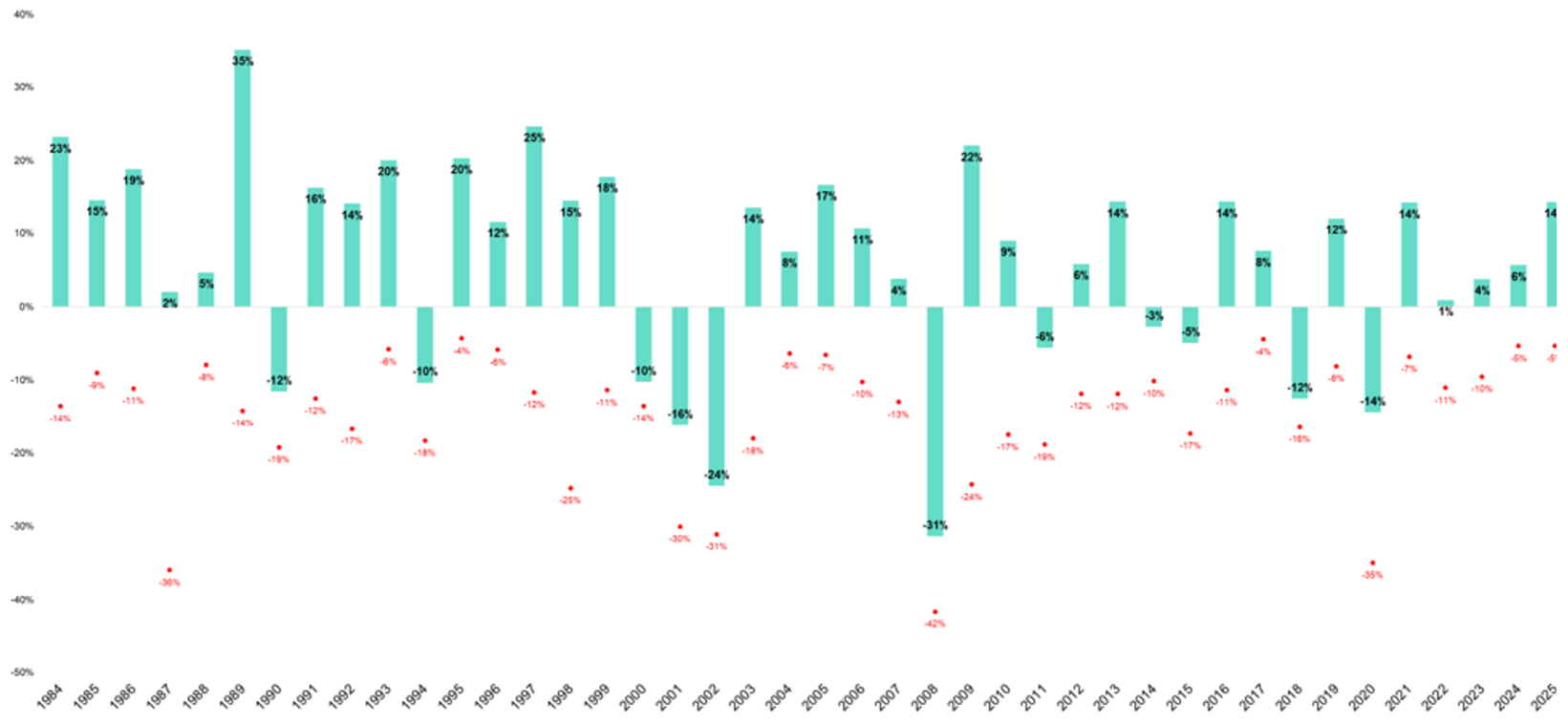
Source: 7IM, FactSet, Past performance is not a guide to future returns, chart(s)/data for illustration purposes and are not for further distribution. Returns and analysis is based on daily total returns. The chart os for illustrative purposes only.
Note: Green bars represent the return each year. Red dots show the maximum decline (drawdown) from the peak during that year.
US
Despite its status as a net oil exporter, the US was not immune to the impact of the war as oil prices rose. The impact on the equity market was quite broad, with technology-related stocks feeling the greatest impact, due to their valuations’ sensitivity to interest rates. US Federal Reserve Chair Jay Powell warned about the conflict’s potential impact on the US economy, as rates were kept on hold, with expectations of inflation ending the year higher than previously and above the Fed’s target.
Although economic and company earnings news took a back seat due to the uncertainty surrounding the impact of the conflict, there were signs of weakness in both the US economy and labour market. GDP for the fourth quarter equated to an annual rate of 0.7%, some way below the previous quarter’s 4.4%. Unemployment also increased, as major companies announced layoffs. At the corporate earnings level, expectations for growth remain at an impressive 14% level, although this did little to provide much support to the market, given the backdrop.
One significant impact of the war for overseas investors was the resulting strength of the dollar, likely caused by increased demand following the international scramble to boost oil supplies, which are mainly traded in dollars. Consequently, negative returns were significantly reduced for sterling investors.
UK
As elsewhere, the performance of the UK market was impacted by events in the Middle East. However, attention here was particularly focussed on the possible impact on future interest rates and government borrowing requirements. Having previously priced in two interest rate cuts this year, investors started to price in interest rate rises due to the likely impact on inflation. This led to the ten-year gilt rising to 5%, the highest level since 2008, as a consequence of the rate speculation. However, public statements by government officials indicating possible support for consumers in the wake of higher energy prices also led to concerns over future borrowing requirements, adding to the speculation. The rises in yields resulted in higher mortgage rates and further speculation about the impact on domestic demand, already likely dampened by higher fuel prices. Although backward-looking economic data took a back seat, weak GDP and unemployment data did little to improve the outlook for the domestic economy. The FTSE 100’s performance was assisted by its diverse mix of industry sectors, including oil companies, and the index still stands at over 2.5% above its level at the start of the year. However, the domestically focussed FTSE 250 index is down over 5%, illustrating the difference in sensitivity to the UK economy.
Europe
Given the wider industrial base, European markets were particularly hard hit by natural gas prices, as these more than doubled almost overnight, as illustrated by the German market declining over 10%. However, less manufacturing-centric markets such as Spain and Italy performed better, serving to dampen the effect on markets in the region as a whole. The impact on inflation was seemingly instant, with a preliminary figure of 2.5% for March announced at the end of the month, up from 1.9% from February and almost entirely attributable to higher energy prices. This is the first time that inflation has breached the 2% since early 2025 and, as with the UK, led to speculation over future interest rate increases.
Japan
Japan is almost entirely reliant on oil imports, and 80 to 90% is transported through the Strait of Hormuz. Clearly, not only is the economy sensitive to the price of oil, but it is also dependent on the Middle East for the physical delivery. So, the risk of shortages is also a reality. This helps to explain the significant market correction in March, albeit coming off the back of an extended strong performance. Again, it helps to keep this move in perspective as the index is still up over 1.4% year to date and more than 30% up over 12 months. The increase in energy prices is exacerbating concerns over inflation levels and putting pressure on the Bank of Japan to raise interest rates, although at their March meeting, they kept their rates on hold. This is hardly surprising, as like other central banks, they don’t want to act too early and suppress growth unnecessarily in case the conflict resolves itself. The ten-year bond yield hit its highest level since the late 1990’s; however, this appears to be a normalisation of the economy after years of deflation. It does raise the cost of borrowing, which conflicts with Prime Minister Takaishi’s desire to stimulate the economy through government spending.
Asia and Emerging Markets
As with Japan, Emerging Markets, particularly in Asia, are heavily reliant on supplies of energy products from the Middle East. Consequently, the impact of the war on the broad emerging market index was equally as negative as Japan, but since the start of the year, it is equally in positive territory. Markets that had generated strong returns in the first two months of the year, such as Korea and Taiwan, were impacted the most, echoing the theme we saw in other markets. However, these markets have still generated double-digit returns year to date despite the correction. China, with its high level of strategic reserves, held up reasonably well in comparison. Latin American markets, with their greater local access to natural resources, also held up well in comparison to Asia.
Summary & Outlook
As regular readers will be aware, portfolio asset allocation is designed at the outset to reduce the effects of outlier events such as we are seeing currently. Therefore, portfolio behaviour has been as expected, i.e. the level of impact being commensurate with risk appetite. Consequently, we are not forced into second-guessing military strategy in the Gulf in terms of portfolio activity. Naturally, human nature means that investors may be concerned about developments, and media speculation can fuel those concerns. Parallels have been drawn with the 1970’s, for instance, but major economies’ consumption of oil has reduced significantly since that time, particularly in the mature economies that have shifted from a manufacturing base to a service industry one. Additionally, we should consider the effects of inflation on the price of oil. In the 1970s, $100 a barrel in real terms was significantly greater than $100 today (think of house prices then and now). So, the impact on economic growth of a $100 oil price today is manageable and estimates don’t indicate serious recessions. Meanwhile, we hope for a swift resolution to the war, for humanitarian reasons as much as financial.
Rockhold Asset Management, with contributions from 7IM, April 2026
.webp)